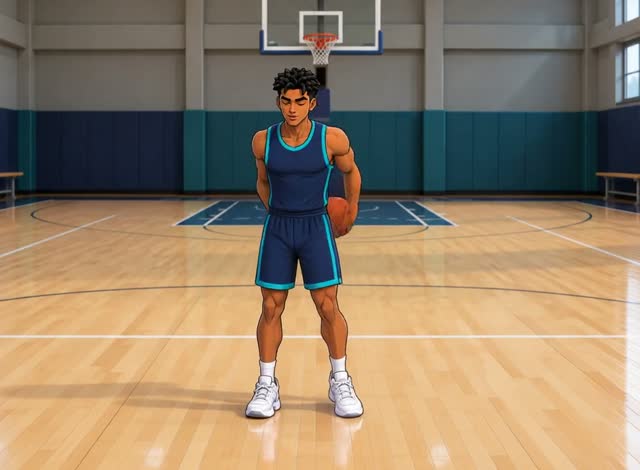
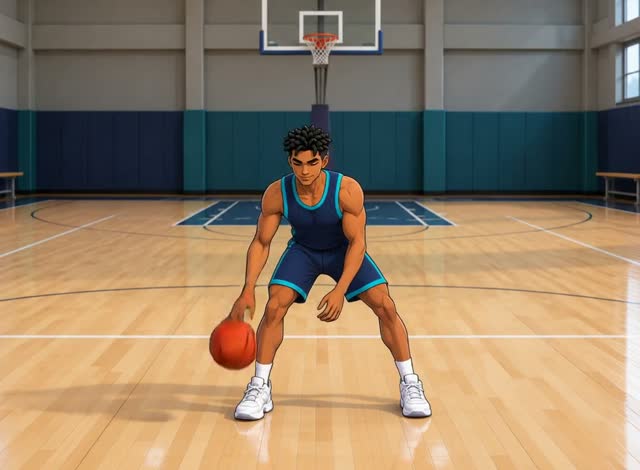
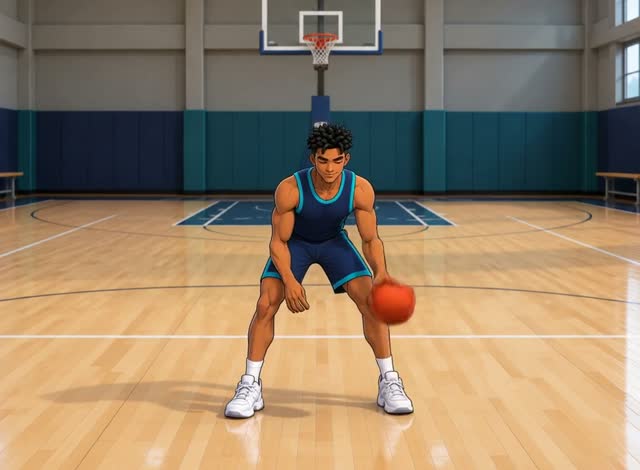
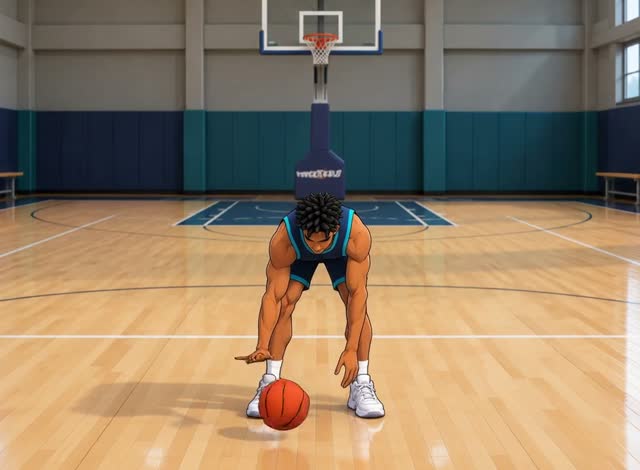
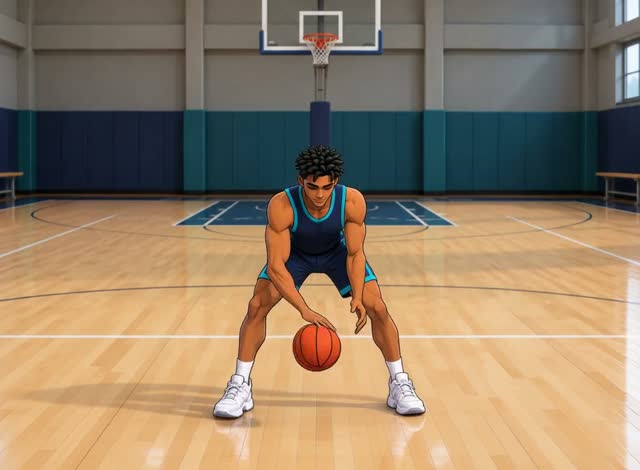
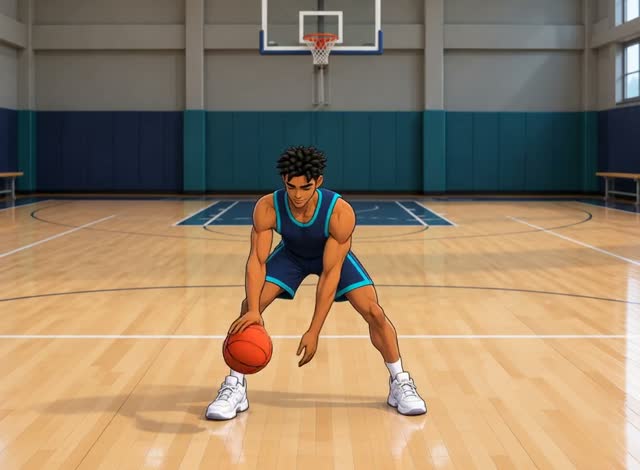
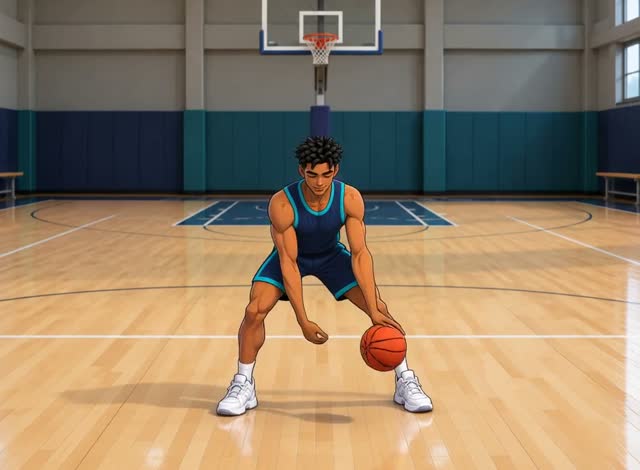
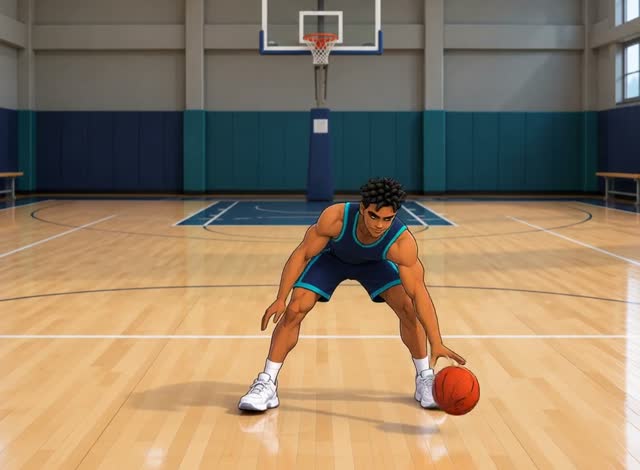
This is a ball handling workout you can follow on your own in 15 minutes. Every row links to a drill page with a looping demo, so you can check form before you start. All you need is a ball, a timer and a flat surface.
The 15-minute follow-along workout
Work for 45 seconds, then rest for 15, on every row after the warm-up. Set an interval timer so you don’t have to watch the clock.
| Block | Drill | Time | Cue |
|---|---|---|---|
| Warm-up | Waist wrap right | 0:00–0:30 | Smooth handoffs, torso still |
| Warm-up | Waist wrap left | 0:30–1:00 | Steady rhythm, no twisting |
| One hand | Right-hand pound | 1:00–2:00 | Pound it hard, knee height |
| One hand | Left-hand pound | 2:00–3:00 | Same force as the other side |
| One hand | Right low fingertip | 3:00–4:00 | Ball by your foot, quick taps |
| One hand | Left low fingertip | 4:00–5:00 | Relaxed wrist, small bounces |
| One hand | Right windshield wiper | 5:00–6:00 | Make a low V, redirect from the top |
| One hand | Left windshield wiper | 6:00–7:00 | Other hand stays free |
| One hand | Weak-hand in-and-out | 7:00–8:00 | Hand on top, never under |
| Switch hands | One-dribble crossover | 8:00–9:00 | Receiving hand ready early |
| Switch hands | Continuous crossover | 9:00–10:00 | Wide stance, low and even |
| Switch hands | One-dribble between the legs | 10:00–11:00 | Side dribble, then through |
| Switch hands | Figure-eight | 11:00–12:00 | Small dribbles, smooth path |
| Finisher | Pound double crossover | 12:00–13:00 | One hard pound, two quick crosses |
| Finisher | Weak-hand pound, eyes up | 13:00–14:00 | Eyes on a target, full effort |
| Finisher | Continuous crossover, counted | 14:00–15:00 | Count clean reps, write it down |
Lefties: use the right in-and-out and right-hand pound for the weak-hand rows.
Why it’s built this way
The order goes from easy to hard on purpose. One-hand drills come first so your touch is warmed up before you switch hands. The weak hand gets two extra rows. The last minute is a test: the same drill on the same clock every day gives you a number to track.
How to progress the workout week to week
Keep the same 15 minutes and change one thing each week. That’s enough to keep improving without turning the session into chaos.
| Week | Work / rest | What changes |
|---|---|---|
| 1 | 30 s / 30 s | Learn the drills. Looking at the ball is fine. Skip between-the-legs and figure-eight if they keep breaking down. |
| 2 | 45 s / 15 s | Full workout. Dribble a little lower on every row. |
| 3 | 45 s / 15 s | Eyes up on every row. Pick a spot on the wall at eye level. |
| 4 | 45 s / 15 s | Push the pace until you lose the ball about once per row. Then start using the swap list below. |
Compare your counted crossover number from week 1 and week 4. If it hasn’t moved, you’re probably going too slow (no mistakes) or too fast (constant mistakes). For a plan that explains the “why” behind each week, read how to improve your ball handling.
The 8-minute version for busy days
On busy days, do eight minutes instead of skipping. Twelve drills at about 40 seconds each, with almost no rest:
- Waist wrap right
- Waist wrap left
- Right-hand pound
- Left-hand pound
- Right low fingertip
- Left low fingertip
- Right windshield wiper
- Left windshield wiper
- Right walk-the-dog
- Left walk-the-dog
- Extra weak-hand pound
- One-dribble crossover
This is the same lineup as the free Foundation Handles workout in the DribbleLift app. That’s a guided version of about eight minutes, with a coach demo playing picture-in-picture and voice cues for each drill, so you don’t need a timer or a drill list.
Advanced swaps once the workout feels easy
When a row feels easy for a full week, swap it for a harder drill that trains the same skill. Change one or two rows at a time, not the whole workout.
| Instead of | Try | Why |
|---|---|---|
| Waist wraps | Stationary spin ball carry | Warms up the turn for spin moves |
| Low fingertip | Floor touch crossover | Forces you to stay low while switching hands |
| Windshield wiper | Low oscillating crossover | Same side-to-side path, now with both hands |
| One-dribble crossover | Dig step crossover or drag step crossover | Adds footwork and a weight shift |
| One-dribble between the legs | Alternating between the legs | No side dribble, so the rhythm is faster |
| Figure-eight | Crossover, between the legs, behind the back | Links three hand changes in a row |
| Pound double crossover | Pound between-the-legs crossover or double crossover pullback | Longer combos that need a clean rhythm |
| Any finisher row | Stationary spin dribble, then continuous spin dribble | Adds the spin move with the ball shielded |
You can also make any row harder without changing the drill: dribble two balls at once on the one-hand rows, or close your eyes for a few seconds on the pound dribble.
How to practice ball handling alone
Practicing alone works well for ball handling because almost every drill is stationary. A few things make solo sessions better:
- Use an interval timer. It keeps the pace honest and stops you from resting too long.
- Put a target on the wall. A sticky note at eye level gives you somewhere to look instead of the ball.
- Film one block a week. Your phone shows things you can’t feel, like a ball bouncing too high on your weak side.
- Choose a flat, hard surface. A garage, basement or driveway works. See dribbling drills at home for quiet options.
If you want an outside opinion on where you stand, take the free DribbleLift dribbling test. You film five short moves, and it gives you a score out of 100 and tells you the first thing to fix.
Mistakes that waste your 15 minutes
- Resting too long. Fifteen minutes only works if most of it is dribbling.
- Doing only the fun rows. The pound and fingertip rows are boring, but they’re where control comes from.
- Never changing anything. If the workout feels the same in week 6 as in week 2, use the swap list.
- Practicing mistakes at full speed. If you lose the ball every few seconds, slow down until it’s clean, then build back up.
Common questions
What is the best ball handling workout?
The best one is the one you do every day. A good workout covers one-hand control, change of direction and your weak hand, and it gets a little harder each week. Fifteen focused minutes that hit all three beat a long session of random moves.
Is this workout OK for a somewhat beginner?
Yes. In week 1, use 30 seconds of work and 30 seconds of rest, and skip the between-the-legs and figure-eight rows if you keep losing the ball. Replace them with more pound and crossover reps. If you're brand new, start with our beginner dribbling drills first.
How can I improve my handling in 30 days?
Run this workout five or six days a week for four weeks and follow the weekly progression: control first, then weak hand, then eyes up, then speed. Count your clean crossovers on day 1 and day 30 so you can see the change instead of guessing.
How do I practice ball handling alone?
You need a ball, a few feet of flat floor and a timer. Set an interval timer for 45 seconds on and 15 off, put a target on the wall at eye level to look at, and film one block a week so you can check your form.