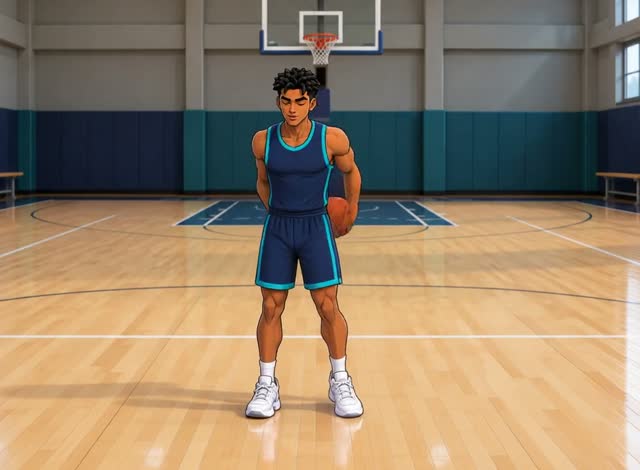
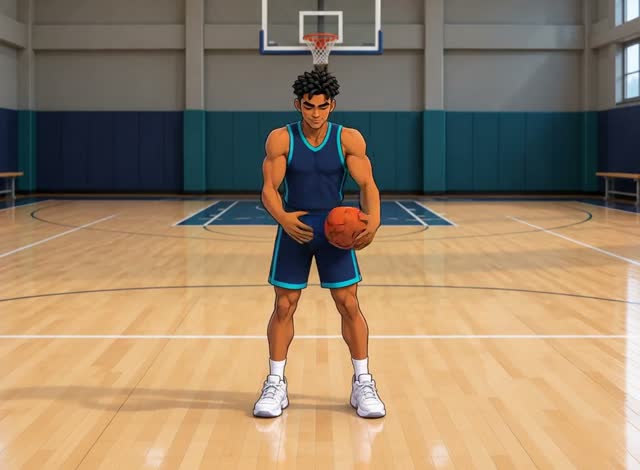
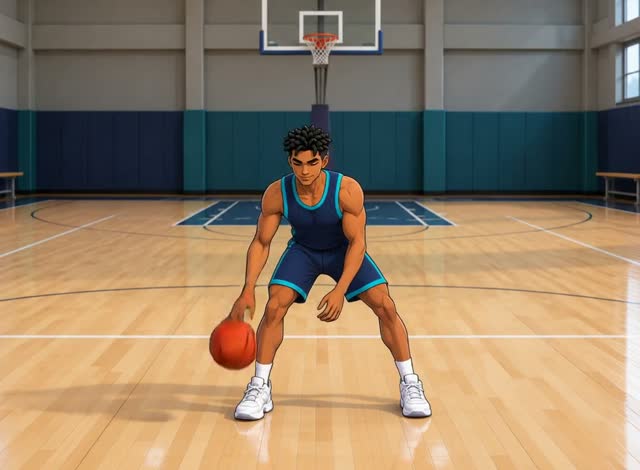
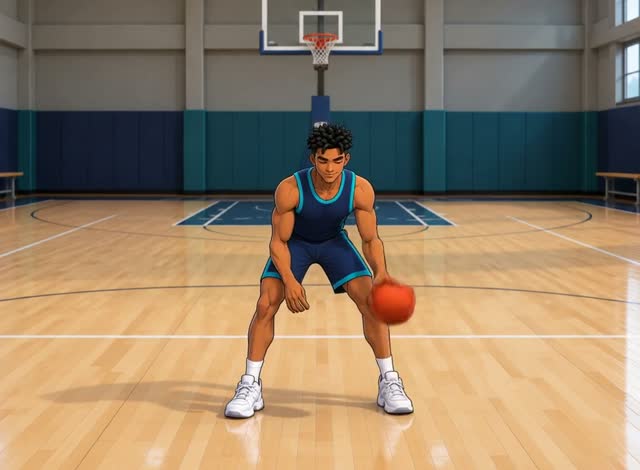
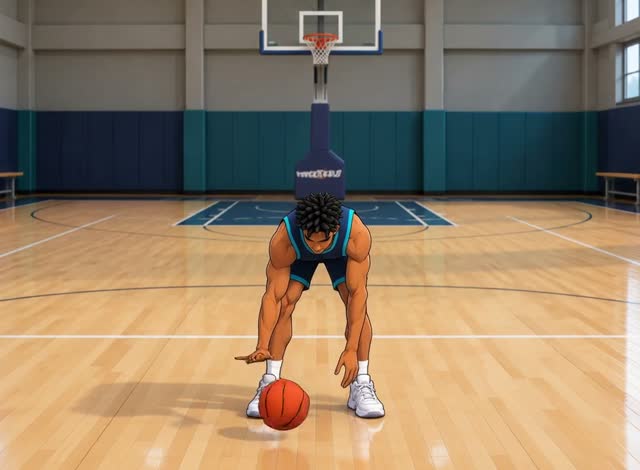
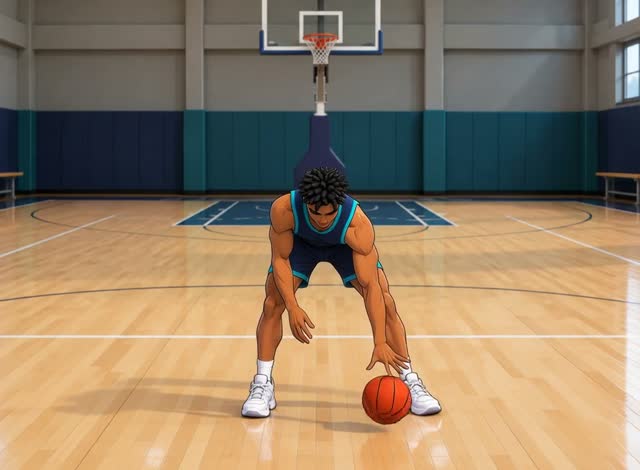
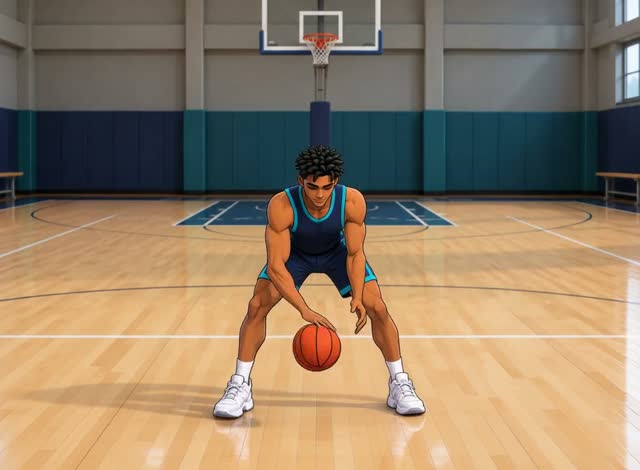
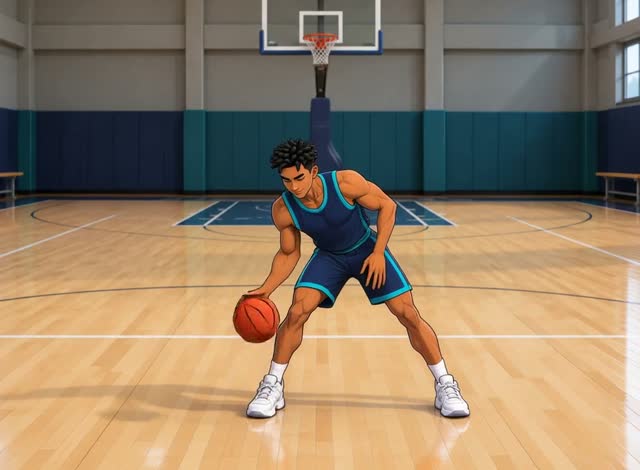
Most ball-handling work doesn’t need a court, a hoop or much room. A bedroom, hallway, garage or basement is enough if you pick the right drills and keep the noise down. This page shows how much space each drill takes, how to practice quietly, and a 10-minute routine you can run every day.
How much space you need for each drill
Most stationary drills fit in a 5 by 5 foot (1.5 by 1.5 m) square. Only drills where your feet travel need more. Use this table to match drills to your room:
| Drill | Floor space | Noise level |
|---|---|---|
| Waist wrap (no dribble) | Room to stand, about 3 ft / 1 m | Silent |
| Figure-eight ball wrap (no dribble) | Room to stand, about 3 ft / 1 m | Silent |
| Low fingertip dribble | About 3 ft / 1 m | Low |
| Pound dribble | About 4 ft / 1.2 m | Loud |
| Windshield wiper | About 5 ft / 1.5 m wide | Medium |
| Walk-the-dog | About 5 ft / 1.5 m front to back | Medium |
| One-dribble crossover | About 5 ft / 1.5 m wide | Medium |
| Figure-eight dribble | About 5 ft / 1.5 m | Low to medium |
| Moving spin dribble | 6–10 ft / 2–3 m to move | Loud |
Low ceilings aren’t a problem. Every drill here keeps the ball below your waist.
How to dribble indoors without making noise
The quietest way to dribble indoors is to dribble lower and softer, over a surface that absorbs the bounce. A ball dropped from knee height makes far less noise than one pounded from the hip. Here are your options, with the honest trade-offs:
| Option | Pros | Cons |
|---|---|---|
| Dribble low | Free, and it’s good technique anyway | Still makes some sound |
| Thin rug or rubber mat | Cuts the slap and the thud to the floor below | Can slide; tape or weigh down the edges |
| Carpet | Very quiet | Thick carpet kills the bounce, so rhythm feels off |
| Foam “silent” basketball | Close to silent, fine for night reps | Lighter, softer and bounces differently |
| No-dribble drills | Completely silent | Builds hand speed and feel, not dribble control |
No-dribble drills are underrated. Waist wraps and figure-eight ball wraps, where you pass the ball around and between your legs without bouncing it, build fast, soft hands. Ball slaps, fingertip taps from hand to hand over your head, and tight wraps around one knee work too.
Are foam “silent” basketballs worth it?
A foam silent ball is worth it if you can only practice when others are asleep. It lets you rehearse patterns like crossovers and between-the-legs dribbles with almost no sound. But it is lighter and slower off the floor than a real ball, so it won’t build the same strength or touch. Treat it as a supplement. Use a real ball whenever the time of day allows, and always finish your week with one.
Clear the space before you start
Before your first dribble, clear about an arm’s length around you in every direction. Move lamps, glass tables, picture frames and anything that can break if the ball gets away. Keep pets and small kids out of the area. Practice on a dry floor in sneakers or with bare feet on a non-slip surface, never in socks on hardwood. If you share a wall with a TV or a window, face away from it.
A 10-minute dribbling routine for home
This routine uses only stationary drills and fits in a 5 by 5 foot space. Work for each block, then move straight to the next one.
- 0:00–1:00 · Warm up. Waist wrap right for 30 seconds, then waist wrap left for 30.
- 1:00–1:30 · Figure-eight ball wrap. Pass the ball around and between your legs in a figure eight. No dribbling.
- 1:30–3:00 · Pound dribble. 30 seconds right hand, 30 seconds left hand, then 30 more on your weak hand.
- 3:00–4:30 · Low fingertip dribble. Right and left, 45 seconds each. Ball beside your foot, quick taps.
- 4:30–6:00 · Windshield wiper. Right and left, 45 seconds each, in a low V.
- 6:00–7:30 · Walk-the-dog. Right and left, 45 seconds each. Push forward, pull back, feet still.
- 7:30–10:00 · Crossovers. One minute of one-dribble crossovers, then 90 seconds of continuous crossovers.
Need it quiet? Swap the pound block for extra low fingertip work, and dribble every drill at shin height. For a longer session, see the 15-minute ball handling workout.
Where to dribble when it’s too cold outside
When it’s too cold to play outside, the best indoor spots are a garage, basement, wide hallway or an unused room with a hard floor. A garage or basement is ideal because you can pound the ball without bothering anyone. Community centers, schools and some apartment buildings have gyms or multipurpose rooms you can book. Covered parking areas work too, if the building allows it. Wherever you go, check the floor for water, gravel or anything that could make you slip.
How to set up your phone camera at home
Filming yourself is the easiest way to coach yourself at home. Set it up like this:
- Distance: 6–10 feet (2–3 m) away, so your whole body and the ball are in frame.
- Height: about waist height. Lean the phone on a shelf, chair or stack of books.
- Framing: head to feet, with a little floor around the ball. If the ball leaves the frame, step back.
- Light: bright and in front of you. A window behind you turns you into a silhouette.
- Background: plain if you can. A clutter-free wall makes the ball easier to see.
Watch the clip for three things: how high the ball bounces, whether your weak hand keeps the rhythm, and whether you’re looking down. If you are, the eyes-up drills fix it.
Training with DribbleLift at home
DribbleLift’s guided workouts were designed for this kind of space. Each one runs about 7–8 minutes with a coach demo on screen and voice cues. During the workout the camera works as a mirror, so you can check your stance and eyes as you go. Nothing is recorded, and workouts run offline. If you want a baseline first, the free dribbling test scores five moves out of 100 and tells you what to fix first. If one hand is clearly behind, start with the weak hand dribbling drills.
Common questions
How do I dribble indoors without making noise?
Dribble low and soft so the ball travels only a few inches, and practice over a thin rug or rubber mat to cut the slap and the thud. When you need near silence, switch to no-dribble work like waist wraps and figure-eight ball wraps, or use a foam "silent" basketball.
Are silent basketballs good for training handles?
They're useful for late-night reps, rhythm and hand-switching patterns. They feel lighter and bounce differently from a real ball, so they won't build the same pound or touch. Use one when you have to be quiet, and finish with a real ball whenever you can.
Can I practice dribbling in an apartment?
Yes, if you plan around your neighbors. Keep loud pound dribbles to daytime hours, put a rug or mat down, and save quiet drills for early mornings and evenings. If you live upstairs, the thud travels through the floor more than the sound travels through the walls.
Do I need a hoop to work on ball handling at home?
No. Ball handling is built with stationary dribbling, and none of the drills on this page use a hoop. A hoop matters for shooting and finishing, not for control, touch or your weak hand.