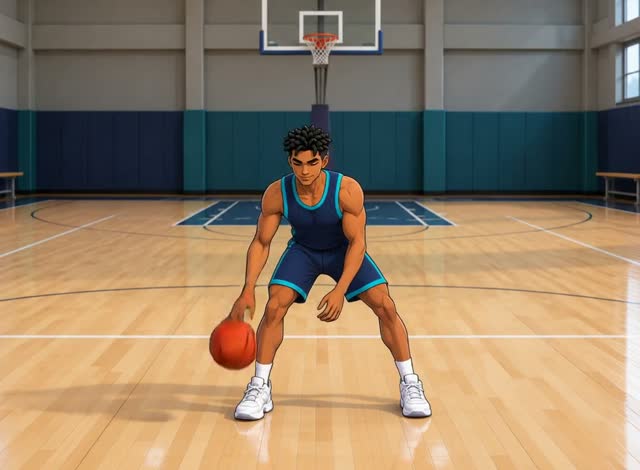
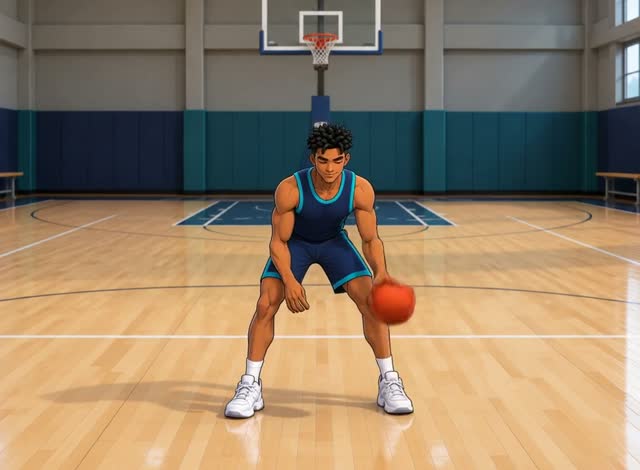
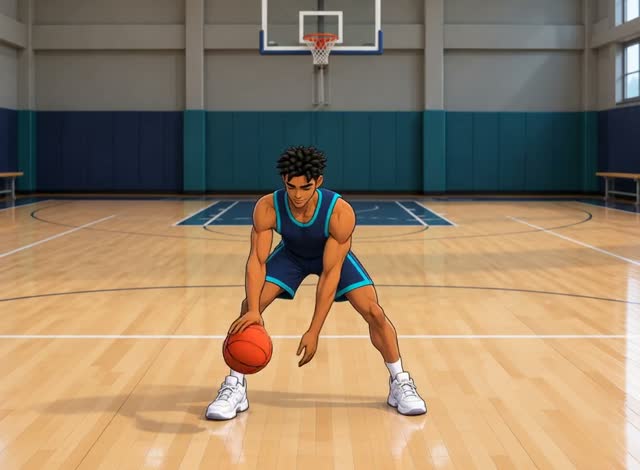
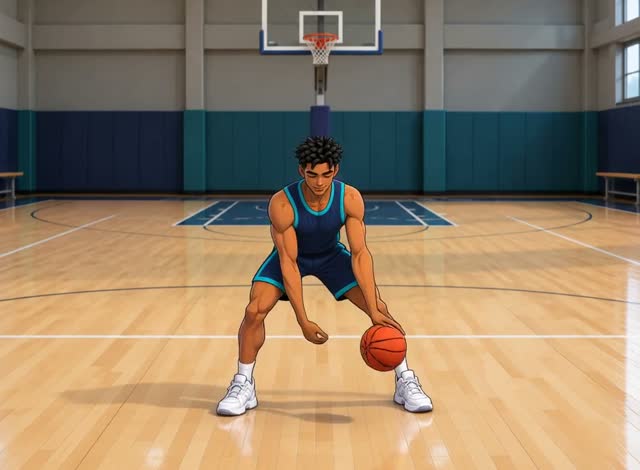
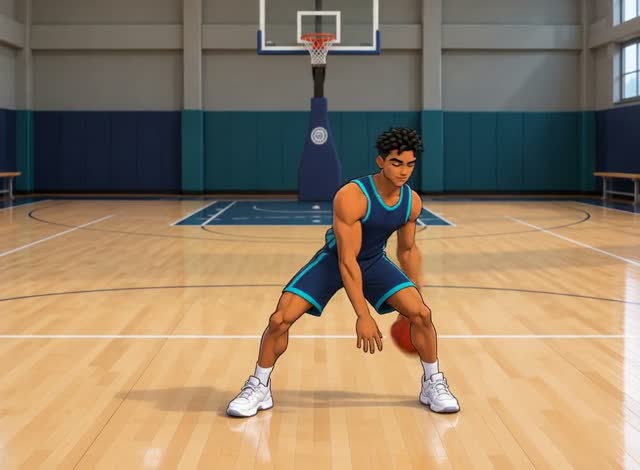
“Rate my handles” is one of the most common posts in basketball forums. Strangers can tell you a lot, but a repeatable test tells you more: you do the same moves the same way every few weeks, and you can see exactly what changed.
What a good dribbling test measures
A useful test checks the parts of a handle you can actually train, one move at a time:
| What it checks | What good looks like |
|---|---|
| Control | The ball comes back to the same spot every bounce, at or below your knee |
| Speed | A quick, firm rhythm you can keep for the full 10 seconds |
| Weak hand | Your off hand matches your strong hand in height, force and rhythm |
| Changing hands | Crossovers stay low and in front of you without a pause |
| Coordination | Between-the-legs dribbles flow without you stopping to reset |
Moves that check these, from easiest to hardest, are the right-hand pound, left-hand pound, one-dribble crossover, continuous crossover and one-dribble between-the-legs.
How to set up your phone
Good footage is most of a good test, whether you score it yourself or let an app do it:
- Distance: place the phone 2–3 m (6–10 ft) away.
- Height: prop it at about waist height, leaning on a wall, a water bottle or a small tripod.
- Frame: your whole body and the ball should be visible the entire time, feet included.
- Light: face a window or turn on every light. Dark clips are the most common reason a test can’t be read.
- Space: clear a few feet around you on flat, hard floor.
The do-it-yourself version
You can run the same test with just your phone’s camera:
- Record each of the five moves for 10 seconds.
- Watch the clips back and give each move 1–5 points for control (did the ball stay low and close?), speed (was the rhythm quick and even?) and eyes (were you looking up?).
- Compare your two pound dribbles. If the weak-hand clip scores two or more points lower, your weak hand is the first thing to train. Our weak hand guide covers how.
- Save the clips and the scores. Repeat the test in three to four weeks with the same setup.
The DIY version works, but it’s hard to grade yourself honestly, and it doesn’t tell you what to do next.
How the DribbleLift assessment works
The DribbleLift app runs the same five moves with a coach demo before each one, then uses AI to score your handle:
- Your score out of 100, plus a breakdown of control, speed and weak-hand skill.
- Your key takeaway: the one thing holding your handle back the most.
- A full written report on what you do well, what to fix and in what order.
- A recommended workout to start with: guided sessions of about 7–8 minutes with a picture-in-picture coach demo and voice cues.
All of that is free. After about five workouts you unlock a retest: you record short clips, and the AI compares them with your last test so you can see exactly what improved. Retest results are ready within 12 hours. As your score climbs, Pro members can take harder tests: the Control Test unlocks at 65 and the Combo Test at 80.
What to do with your results
- Weak hand far behind: spend two-thirds of every session on your weak hand. Start with the 15-minute ball handling workout and double the weak-hand blocks.
- Control is the weak spot: slow down. Pound and low fingertip dribbles at a pace where you never lose the ball.
- Speed is the weak spot: you’re probably controlled but cautious. Push the pace until you lose the ball about once every 30 seconds.
- Crossovers and between-the-legs are the weak spot: build them from single reps (one-dribble crossover) before continuous ones.
Then retest after three to four weeks of regular practice. How quickly scores move depends on how often you train; our guide on how long it takes to get good handles has realistic timelines.
Common questions
Is the DribbleLift dribbling test free?
Yes. Your first assessment score, the breakdown and the full written report are free, and so are retest scores. DribbleLift Pro adds drill-by-drill retest coaching and your next focus area.
How long does the test take?
About five minutes including setup. Each move is recorded for 10 seconds, and the coach demo shows you the move before each one. First results usually appear within seconds.
Do I need a hoop or a smart basketball?
No. Any basketball works, and you need only a few feet of flat floor. The test uses your phone camera — no sensors, smart ball or wearables.
Is my video saved?
Your first assessment uses still snapshots, and no video is saved. Retest clips are uploaded only so they can be analyzed and are deleted automatically after 30 days. Only your scores and report text are kept.
What is a good dribbling score?
The number matters less than the change. Your first score is your baseline; what tells you your training works is the score going up on your retest. The breakdown shows whether control, speed or your weak hand is holding the total back.