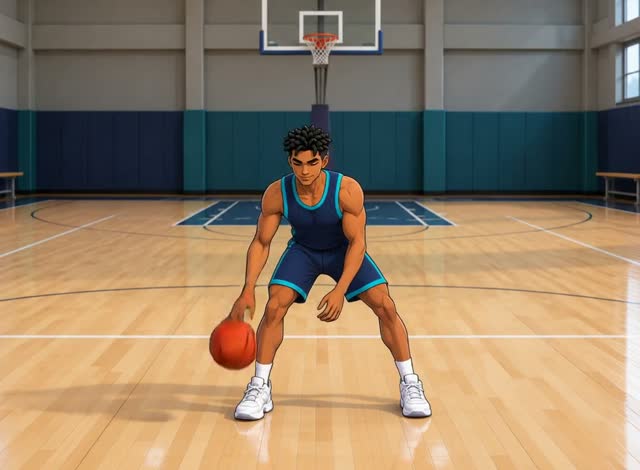
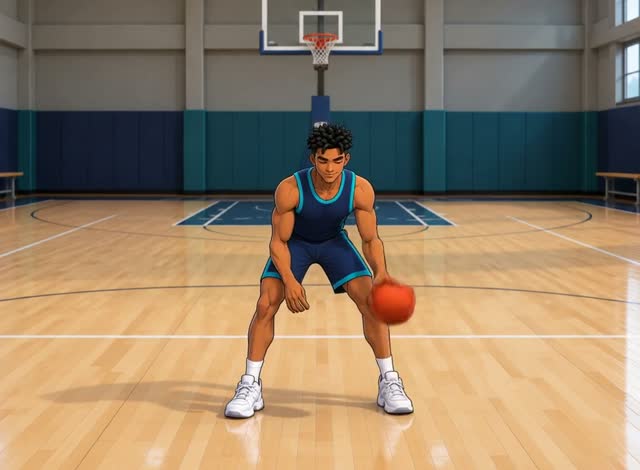
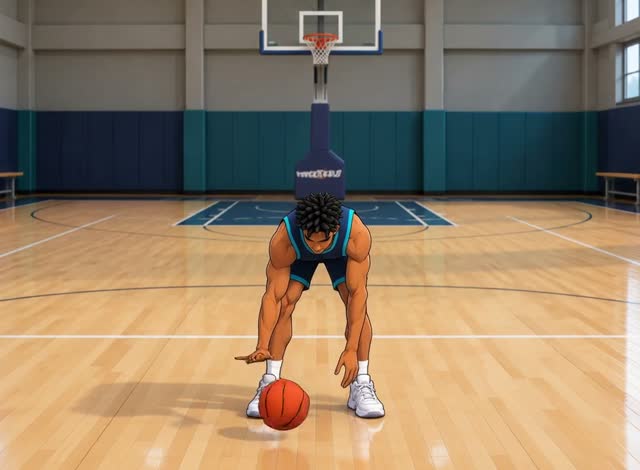
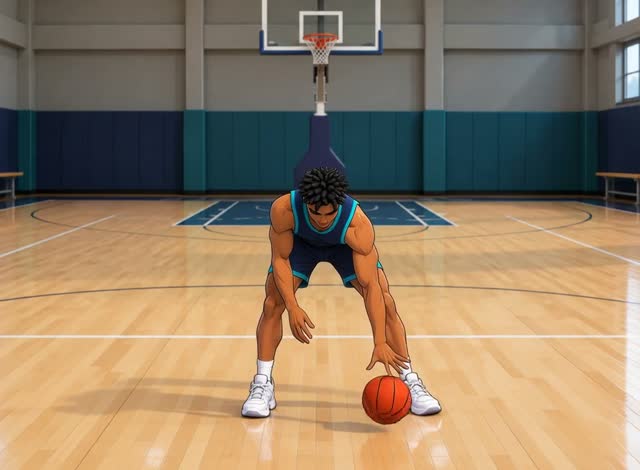
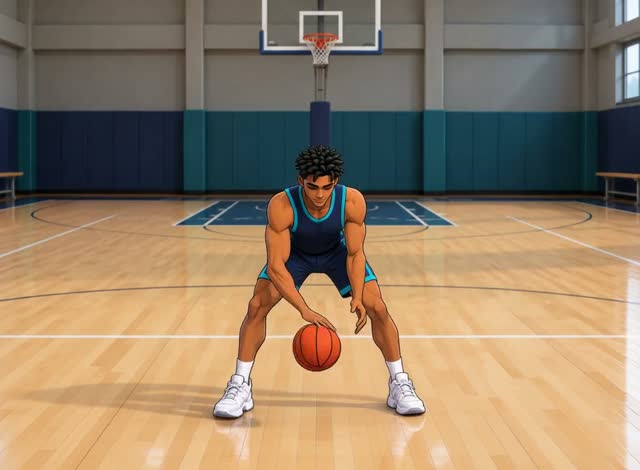
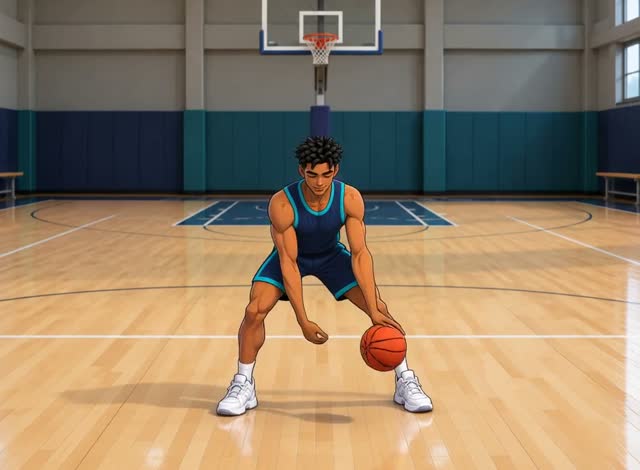
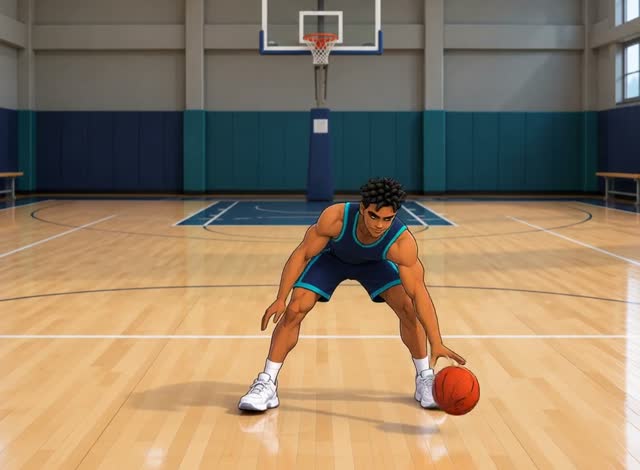
You look down because your hand doesn’t trust the bounce yet. The fix isn’t forcing your eyes up and losing the ball every few seconds. It’s building enough control that you don’t need to look, then training your eyes to stay up while the drills get harder.
Why players look down when they dribble
Players look at the ball because they’re not sure where it will come back. That uncertainty usually has one of these causes:
- The dribble is too high or too soft. A weak, high bounce wanders, so you watch it. A hard, low pound dribble comes back to the same spot.
- You’re using your palm. Fingertip control gives you feel. Palm slaps don’t, so your eyes take over.
- You’re going too fast. Speed beyond your control forces you to watch every bounce.
- The habit was never broken. If you’ve always practiced eyes-down, your eyes go there by default.
- You’re nervous. In games, fear of a turnover pulls your eyes to the ball even when your hands are fine.
The first three are technique. Fix those and the drills below get much easier.
6 drills to dribble with your eyes up
Do these in order. Move to the next drill when you can finish a 30-second set of the current one with your eyes up and no more than one lost ball.
| # | Drill | What makes it harder | Base dribble |
|---|---|---|---|
| 1 | Wall target | Eyes fixed on one spot | Pound dribble |
| 2 | Mirror check | You see the ball only in the reflection | Low fingertip, windshield wiper |
| 3 | TV dribbling | Your attention is somewhere else | Continuous crossover |
| 4 | Eyes-closed pounds | No vision at all, for short sets | Pound dribble |
| 5 | Call the fingers | You react to what you see | Continuous crossover, figure-eight |
| 6 | Tennis-ball toss | Your free hand is busy too | Pound dribble |
1. Wall target
Put a piece of tape on the wall at head height, 6–10 feet in front of you. Pound dribble with your right hand for 30 seconds, eyes on the tape the whole time. Then switch to your left hand. If you lose the ball, lower your stance and dribble harder rather than slowing down.
2. Mirror check
Stand in front of a mirror, or prop your phone up with the front camera on as a mirror. Do low fingertip dribbles and windshield wipers while you look at your face in the reflection. You can still see the ball at the edge of your vision, which teaches you to track it without dropping your head. If your chin drops in the mirror, you caught yourself looking down.
3. Dribble while you watch TV
Put on a game or a show and run continuous crossovers during one segment. Your attention goes to the screen, and your hands have to run on feel. This is the easiest way to pile up eyes-up minutes. Clear the space first and keep well back from the TV.
4. Eyes-closed pounds
Stand still in a clear space and pound dribble with your eyes closed for 10–15 seconds. Then open them, reset and go again. Keep it to a stationary pound with one hand. This drill builds pure feel, because the only information you get is from your fingertips. If the ball drifts away, open your eyes and stop it. Don’t try to chase it blind.
5. Call the fingers
Have a partner stand in front of you and hold up a number of fingers. Change it every two or three seconds while you do continuous crossovers or the figure-eight, and call out each number. No partner? Have a phone play random numbers or colors and call those out instead. This is the closest drill to a game, where you have to see and react while dribbling.
6. Tennis-ball toss
Pound dribble with one hand while you toss a tennis ball up and catch it with the other. Start with small tosses at chest height. When that’s steady, toss it against a wall and catch it. Switch hands every set. This is the hardest drill on the list, because both hands and your eyes are all doing different jobs.
How to keep your eyes up in games
Drills get your eyes up in practice. Games need one more step: doing it while moving and while someone is trying to take the ball. Work through this progression:
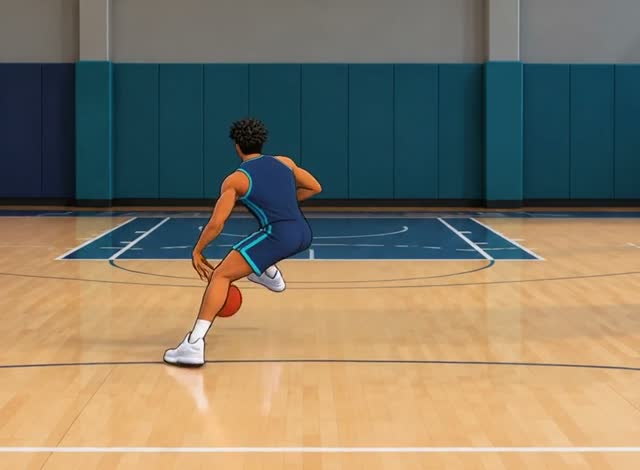
- Move. Walk, then jog, while dribbling with your eyes on a target. Once that’s clean, add a moving spin dribble (it needs 6–10 feet of space).
- Add a hand in your face. Have a partner wave a hand or poke at the ball while you keep a stationary dribble alive.
- Play 1-on-1. Short possessions, one move each. Focus on seeing your defender’s feet and hips, not the ball.
- Use it in pickup. Pick one move you trust, like a crossover, and use it at least a few times every game.
Dribbling under pressure
When a defender pressures you, keep the dribble low and on the side away from them. Use your body and off arm to shield the ball, without pushing off. Keep your eyes up so you can see help defenders and open teammates. A hard, low dribble is the hardest to steal. A high, soft one is the easiest.
How to stop being scared to use your handles
Fear in games usually means you haven’t had enough pressure reps in practice. Get them in low-stakes settings first, like 1-on-1s with a friend or casual pickup. Then set a goal you control, such as attacking with your weak hand three times a game. Count the attempts, not the turnovers. Confidence comes from seeing that you can survive a mistake.
Check your eyes with your phone
The easiest way to check your eyes is to film a 30-second drill and watch it back. If your chin drops on every bounce, go back a step in the progression. During DribbleLift’s guided workouts, the camera works as a mirror, so you can check your head position as you train, and nothing is recorded. To see where you stand overall, the free dribbling test scores five moves out of 100. For more on the fundamentals behind an eyes-up handle, read how to improve your ball handling. If you practice in a small room, see the dribbling drills at home guide.
Common questions
How do I dribble without looking down?
Pick one dribble you can already do without losing the ball and fix your eyes on a spot on the wall at head height. Once that's easy, add distractions like calling out a partner's fingers or tossing a tennis ball. Your eyes come up when your hand trusts the bounce.
How long does it take to dribble without looking?
On simple stationary dribbles, most players can keep their eyes up within a week or two of daily practice. Doing it during crossovers, combos and moving drills takes longer, often a couple of months. Each new move starts eyes-down and needs its own eyes-up reps.
How do I stop being scared to use my handles in games?
Build the confidence in practice first with pressure reps: a partner reaching for the ball, 1-on-1s and pickup games where mistakes don't matter. Then set a small goal, like using your weak hand three times a game, and judge yourself on attempts rather than results.
Is it OK for beginners to look at the ball?
Yes, for the first few days of a new drill. Watching the ball while you learn the pattern is normal. Start lifting your eyes as soon as the ball comes back to the same spot most of the time, or the habit sticks.