This guide is for teens and adults who are new to basketball, or who never learned to dribble properly. It covers how to dribble the right way, eight drills in the order to learn them, and what to do once the basics feel easy.
How to dribble a basketball: the basics
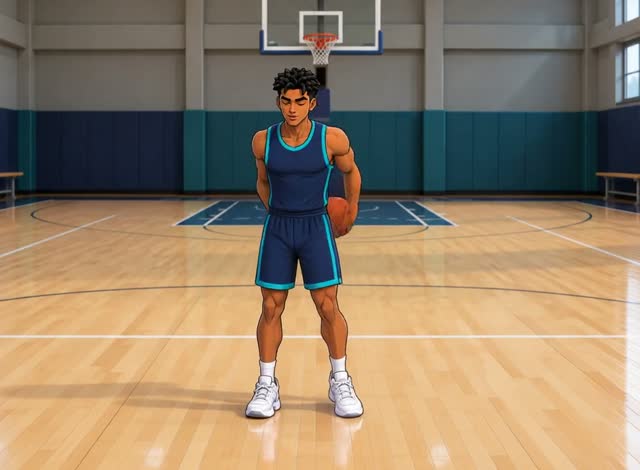
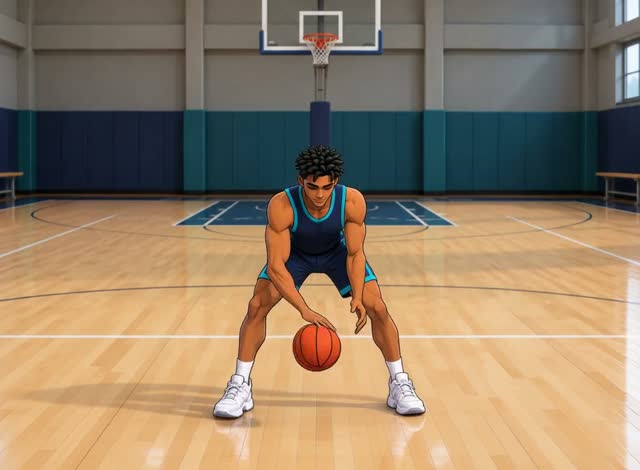
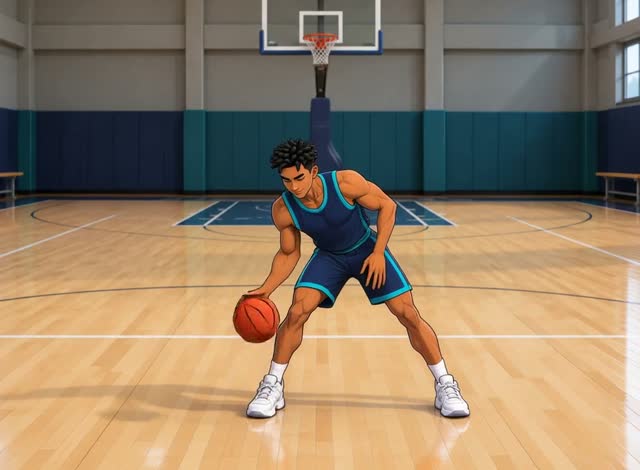
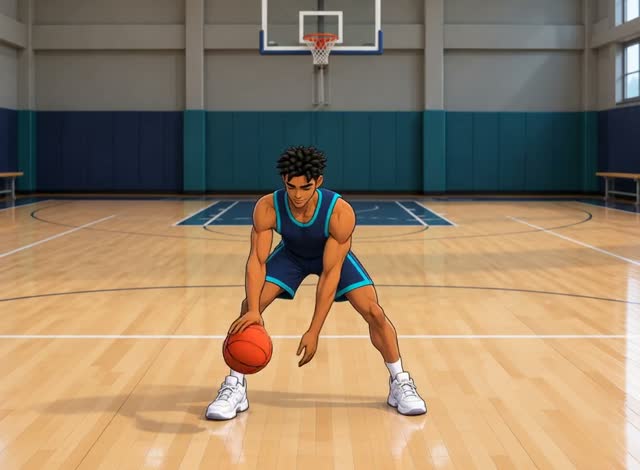
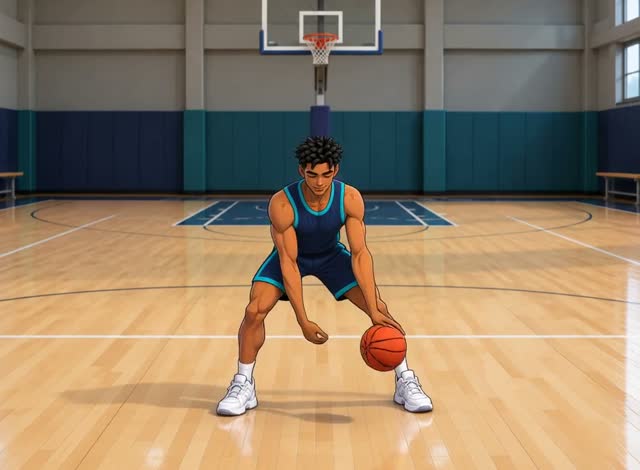
Good dribbling starts with your body position, not your hand. Get these six things right and every drill gets easier:
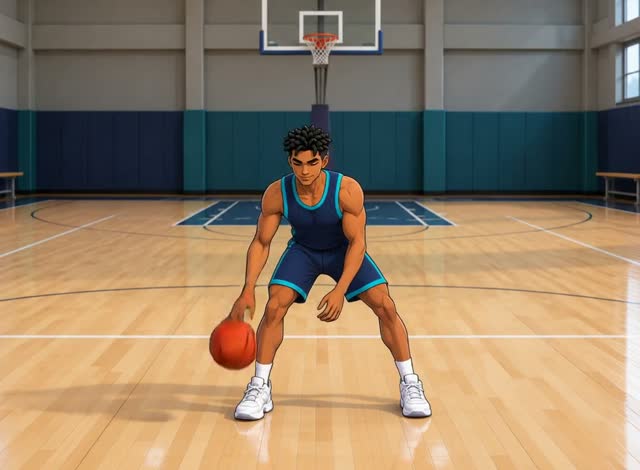
- Get in a stance. Feet about shoulder-width apart, knees bent, hips back, chest up. You should feel it in your legs.
- Use your fingertips. Spread your fingers and touch the ball with the pads of your fingers. Your palm should barely touch it.
- Push, don’t slap. Push the ball into the floor with your wrist and forearm. When it comes back up, let your hand ride up with it, then push again.
- Keep it low. Dribble no higher than your waist. Knee height is better. A lower ball is easier to control and harder to steal.
- Keep it to the side. Dribble beside your foot, not right in front of you, so you don’t kick it.
- Bring your eyes up slowly. Looking at the ball is normal at first. Each week, try to look at a spot on the wall for a little longer.
Your free arm stays bent and out in front of you, as if you’re protecting the ball from a defender.
Why do beginners keep losing the ball?
Beginners usually lose the ball for one of four reasons. Fix the cause, and the ball stops getting away.
| Problem | What’s happening | Fix |
|---|---|---|
| Ball bounces away from you | You’re pushing it forward instead of down | Push straight down, beside your foot |
| Ball comes up too slow | Dribble is too soft | Push harder; a firm dribble is easier to control |
| You lose it when switching hands | Ball is too high when it crosses | Cross below your knees |
| You keep fumbling | You’re slapping with your palm | Spread your fingers and use your wrist |
Your equipment matters too. A ball that’s low on air won’t bounce back properly, and cracked or uneven ground sends it sideways.
8 beginner dribbling drills, in order
Learn these one or two at a time. Move on when you can do a drill for 30 seconds without losing the ball. Difficulty is from 1 (easiest) to 5, as rated in the drill library.
| # | Drill | Difficulty | What it teaches |
|---|---|---|---|
| 1 | Waist wraps | 1 | Feel for the ball, hand-to-hand passing |
| 2 | Pound dribble | 1–2 | A firm, controlled dribble with each hand |
| 3 | Low fingertip dribble | 2 | Touch and quick wrist control |
| 4 | Windshield wiper | 2 | Moving the ball side to side with one hand |
| 5 | Walk-the-dog | 2 | Moving the ball forward and back |
| 6 | In-and-out | 3 | Your first one-hand fake |
| 7 | One-dribble crossover | 3 | Switching hands cleanly |
| 8 | Continuous crossover | 3 | Switching hands with rhythm |
Do every one-hand drill with both hands. Each has a left-hand version in the library.
1. Waist wraps
Pass the ball around your waist, hand to hand, one way and then the other. There’s no dribbling yet. It teaches your hands to grip and release the ball, and it’s the warm-up for every session.
2. Pound dribble
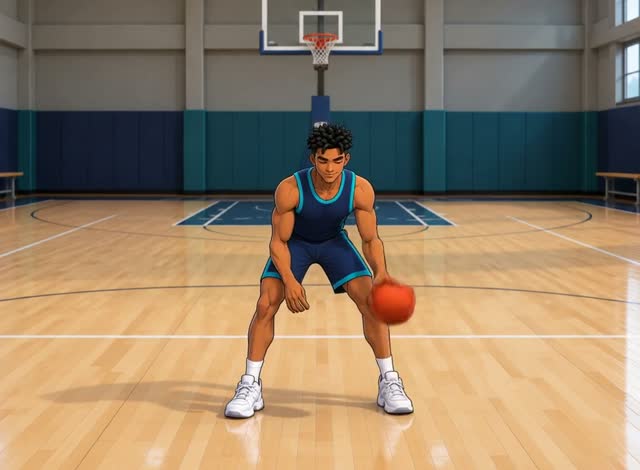
Dribble hard beside one leg at knee height, then switch hands. This is the most important drill on the list. Spend extra time on your weaker hand from the start; the weak hand dribbling guide explains why.
3. Low fingertip dribble
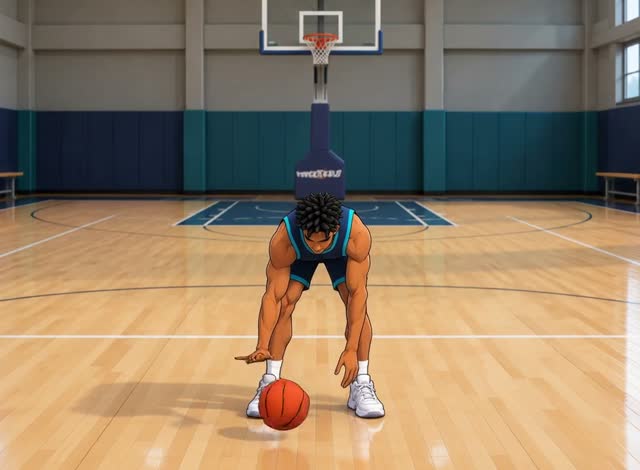
Get lower and tap the ball quickly beside your foot with small movements. The bounce is tiny, so you have to use your fingers, not your arm.
4. Windshield wiper
With one hand, dribble the ball side to side in front of you in a low V. Push from the upper side of the ball to change its direction. Keep your other hand free.
5. Walk-the-dog
Turn your body slightly and push the ball forward, then pull it back beside the same leg. Your feet stay still. This is the base of dribbling while moving.
6. In-and-out
Guide the ball toward the middle of your body, then back out with the same hand, like you’re faking a crossover. Keep your hand on top or on the side of the ball. Going underneath it is a carry.
7. One-dribble crossover
One dribble at your side, then push the ball low across your body to the other hand. Get the receiving hand ready before the ball arrives.
8. Continuous crossover
Cross the ball back and forth in front of you without stopping. Use a wide stance and keep every bounce low and even. When you can do this for 30 seconds with your eyes up, you’ve got the basics.
What dribble moves should beginners learn first?
Learn the crossover, then the in-and-out, then between the legs. The crossover is the move you’ll use most. The in-and-out is a simple fake with one hand. Between the legs protects the ball with your body when you switch hands.
Skip the behind-the-back and spin moves for now. They look great, but they rely on the control the eight drills above are building.
Starting dribbling as a teen or adult
Starting later is fine. You’ll just practice differently from a kid on a youth team. Teens and adults can follow a plan, focus for 10–15 minutes and notice their own mistakes. Use that:
- Practice short and often. Ten minutes a day works better than one long session a week.
- Use the demos. Each drill page has a looping video. Watch it, do the drill, then film yourself and compare.
- Follow a set routine. Once you know the eight drills, the 15-minute ball handling workout puts them in order with a timer.
- Get a baseline. The free DribbleLift assessment (13+) scores five basic moves out of 100 from your phone camera and tells you what to fix first. It gives you a starting point and a way to measure progress without a coach.
What to learn after the basics
Once all eight drills feel easy, add harder drills one at a time:
- Figure-eight: the ball weaves around and between your legs.
- One-dribble between the legs: your first between-the-legs move.
- Pound double crossover: your first combo.
- Stationary spin ball carry: the footwork for a spin move, without the dribble.
From there, the how to improve your ball handling guide has a four-week plan to keep you moving forward.
Beginner dribbling mistakes
- Learning moves before control. A crossover on top of a wobbly dribble is just a turnover.
- Only using your strong hand. It’s the easiest habit to form and the hardest to break later.
- Standing straight up. If your legs aren’t tired, you’re probably too tall.
- Dribbling too softly. Beginners often tap the ball gently to stay safe. A harder dribble is actually easier to control.
- Watching the ball forever. Looking down is fine in week 1. By week 3, try to keep your eyes up for most of each drill.
Common questions
What are the best dribble moves to focus on as a beginner?
Learn the crossover first, then the in-and-out, then between the legs. Those three cover most of what you need in pickup games. Leave the spin and behind-the-back until your pound dribble and crossover are solid with both hands.
How do I stop losing the ball when I dribble?
Dribble lower, push with your fingertips instead of slapping with your palm, and slow down. Most lost balls come from dribbling too high, too fast or standing straight up. Also check that your ball is properly inflated and the floor is flat.
I'm 25 and just starting. Where should I start with dribbling practice?
Start with the eight drills on this page, 10–15 minutes a day, and use the drill pages to check your form against the demo videos. Filming yourself once a week helps a lot when you don't have a coach. Adults often move through the early drills quickly because they can focus well in short sessions.
How long until I'm comfortable dribbling?
Most beginners who practice daily feel steady on the basic stationary drills within two to three weeks. Getting comfortable dribbling on the move against a defender takes longer, often a few months. It varies a lot with how often you practice and how often you play.