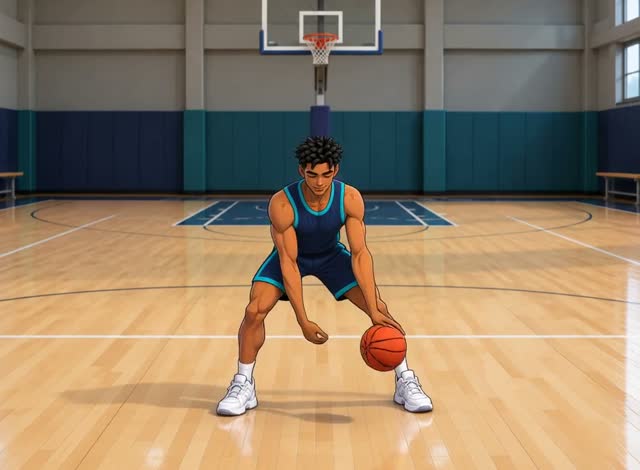
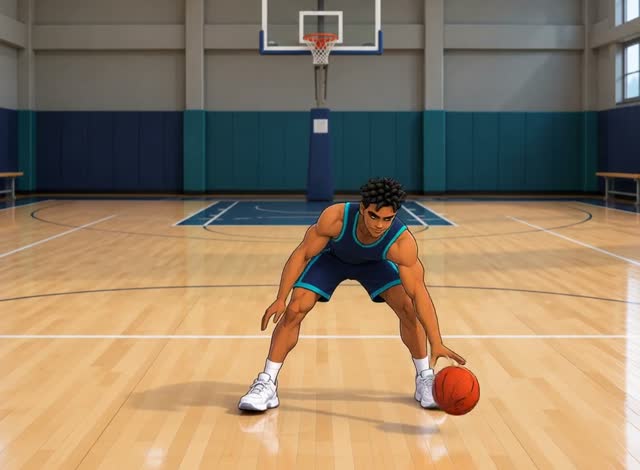
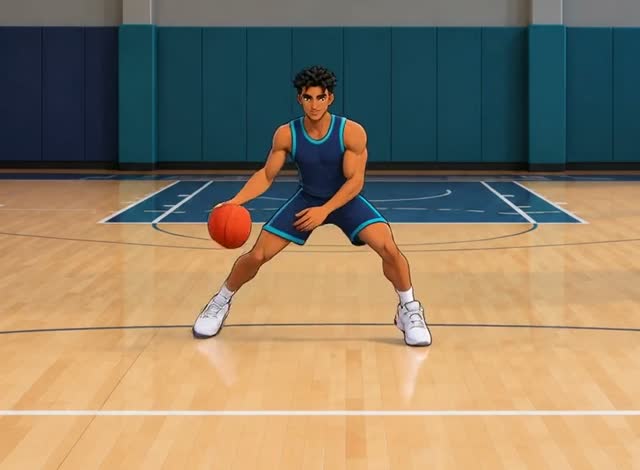
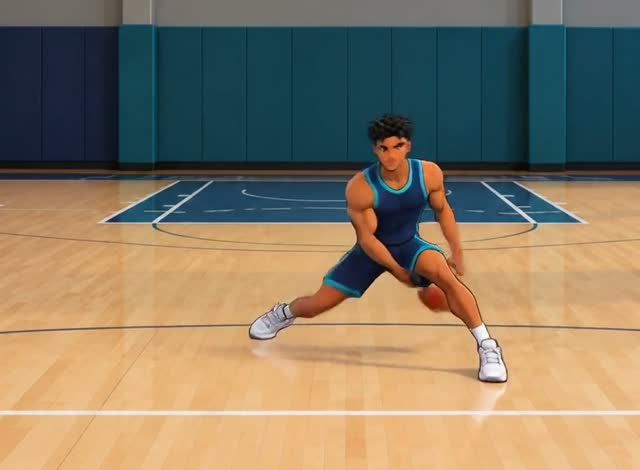
There’s no single number, because “good handles” means different things at different levels. What you can count on is a rough sequence: control first, then switching hands, then combos, then game speed. This page lays out how long each stage typically takes, what changes the pace, and how to tell whether you’re on track.
A realistic ball-handling timeline
The table below assumes 15–20 minutes of focused dribbling, five to six days a week. These are typical ranges, not promises. Complete beginners tend to sit at the slow end. Players returning to the game, or who already play other ball sports, often move faster.
| Stage | Typical time | What you can do |
|---|---|---|
| 1. Getting a feel | Weeks 1–2 | Pound and fingertip dribble with each hand. The ball stops wandering, but you still glance down. |
| 2. Basic control | Weeks 3–6 | Strong and weak hand both keep an even rhythm at knee height. Clean one-dribble crossovers. |
| 3. Switching hands | Months 2–3 | Continuous crossovers, between-the-legs and the figure-eight at a steady pace, mostly eyes up. |
| 4. Combos | Months 3–6 | Chains like the pound double crossover at speed. One or two moves start showing up in pickup games. |
| 5. Game speed | Months 6–12 | Moves under pressure while reading the defense. The weak hand is a real option, not a liability. |
| 6. Your own handle | 1 year and beyond | Counters, change of pace and moves that fit your game. This stage never really ends. |
If you skip days often, stretch every range. If you practice daily and test yourself, you’ll often land at the faster end.
What speeds up your progress
The players who improve fastest do a few simple things consistently:
- They practice almost every day. Short daily sessions keep the feel fresh. A week off costs more than you’d think.
- They train the weak hand hardest. It has the most room to improve, so it pays back the fastest.
- They practice at the edge of control. Losing the ball about once every block means you’re working. Never losing it means it’s too easy.
- They lift their eyes early. Once a drill is clean, they stop watching the ball. See how to dribble without looking.
- They get feedback. A video, a rep count or a scored test shows what to fix instead of guessing.
- They play live. 1-on-1s and pickup games teach timing that drills can’t.
What slows you down
Most slow progress comes from the way you practice, not from talent:
- Long, rare sessions. Two hours on Saturday is less effective than 20 minutes every day.
- Strong-hand comfort reps. Practicing what already feels good adds very little.
- Collecting moves. Learning ten new moves before your pound dribble is solid spreads your reps too thin.
- Speed before control. Fast and sloppy just trains fast and sloppy.
- Standing tall. If your knees aren’t bent, every drill gets harder to control.
Is it too late to get good handles?
It’s not too late at 16, 21, 29 or older. Ball handling is a skill you learn through repetition, and the method is the same at any age. What differs between teens and adults is practical, not magical:
| Teens | Adults | |
|---|---|---|
| Time | Usually more free time, more pickup games | Less time, so sessions need to be short and planned |
| Habits | Often play more and practice less deliberately | Better at following a plan and tracking progress |
| Mindset | Usually less worried about looking awkward | More self-conscious, which can make them avoid hard drills |
| Recovery | Can often handle long sessions | Benefit from a real warm-up and steady volume |
If you’re an adult, set a goal that fits your life: being comfortable in pickup or a rec league, using your weak hand without thinking, or beating your last test score. Those goals are well within reach.
How much should you practice per day and per week?
For most players, 15–20 minutes a day, five to six days a week, is the sweet spot. That’s enough volume to improve without burning out. Here’s how to scale it:
| Level | Daily | Weekly |
|---|---|---|
| Beginner | 10–15 min of stationary drills | 5–6 days |
| Intermediate | 15–20 min, drills plus combos | 5–6 days, plus 1–2 pickup sessions |
| Game player | 20–30 min, including moving drills and pressure | 5 days, plus live play |
| Young players (middle school) | 15–20 min, mixed with games | Most days, on top of team practice |
If you want a ready-made session, use the 15-minute ball handling workout. If you’re starting from scratch, the 4-week ball handling plan gives each week a single focus.
How to measure your progress
Pick a measure, record a starting point, and recheck it every two to four weeks under the same conditions. Feeling better is a good sign, but numbers and video are easier to trust.
- Count clean reps. How many continuous crossovers can you do in 30 seconds without losing the ball? Do the same count with a weak-hand pound dribble.
- Time a no-loss streak. How long can you run the figure-eight before the ball gets away?
- Film the same drill. Same spot, same angle, same drill. Compare ball height, rhythm and where your eyes are.
- Take a scored retest. The free DribbleLift dribbling test scores five moves out of 100, with a breakdown of control, speed and weak-hand skill. A retest a few weeks later is compared with your last one, so you can see what actually improved.
Write your numbers down. When progress feels slow, seeing your crossover count climb from one month to the next will keep you going.
Common questions
How fast can you get good at dribbling?
Most players notice a real difference in two to four weeks of daily practice: the ball comes back to the same spot and the weak hand stops feeling clumsy. Getting good enough to use moves in games usually takes several months. Short daily sessions get you there faster than long, rare ones.
Is it too late to get better handles at 21 or 29?
No. Adults improve their handles with the same short, frequent practice teens use. You may have less free time, so consistency is the hard part. Fifteen minutes a day, five days a week, is enough to see clear progress within a couple of months.
How long until I can dribble at game speed?
For most players it takes six months to a year of steady practice, plus regular live play. Drills build control, but game speed also means handling the ball while a defender reaches and you read the floor. Add 1-on-1s, partner pressure or pickup games once your drills are clean.
How often should a 6th grade point guard dribble on their own?
About 15–20 minutes most days, on top of team practice, is plenty. Keep sessions short and varied so they stay fun, give the weak hand extra reps, and mix in games like dribble tag or 1-on-1. Consistency over months matters far more than long sessions at that age.